
Lesson
Opportunity Cost
Summary
Every choice has a hidden cost, called the opportunity cost. In this lesson, students evaluate trade-offs by identifying the next-best alternative they give up when making a decision.
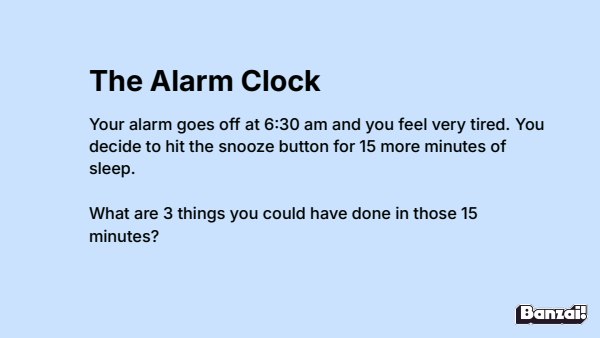
Bellringer: The Alarm Clock
- Students brainstorm 3 things they could have done instead of hitting snooze for 15 minutes.
- Bridge responses to the concept of opportunity cost.
Instruction
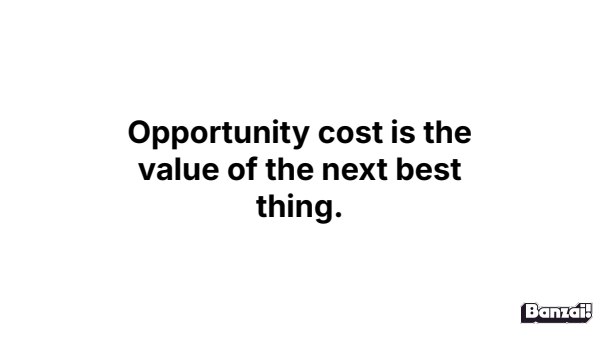
- Define opportunity cost as the value of the next best thing.
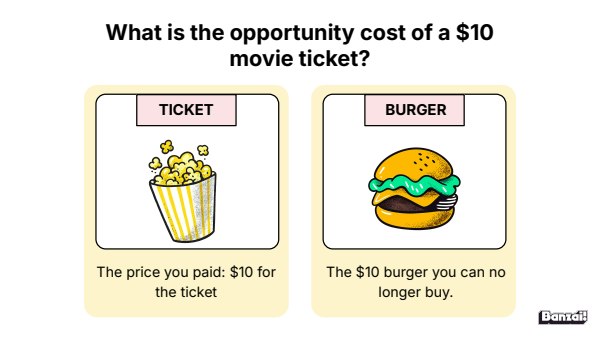
- Walk through the movie ticket vs. burger example and discuss subjectivity of opportunity cost.
- Introduce marginal analysis as a tool for evaluating trade-offs at the margin.
Activity: Opportunity Cost Article & Trade Log
- Students read the Opportunity Cost article independently or in pairs.
- Briefly debrief key takeaways before moving on.
- Assign the Opportunity Cost Trade Log homework worksheet, due the following day.
Discussion: Maya's Trade-Off
- Present Maya's job scenario and walk through Tasks 1–3.
- Push students to defend their advice using cost, opportunity cost, and long-term consequences.
Wrap-Up & Assessment
- Give one example of opportunity cost.
- Explain how you will evaluate opportunity costs and make a financial decision when it’s tough.
| Est. Time | Activity | Description |
|---|---|---|
| 5 min | Bellringer: The Alarm Clock |
|
| 15 min | Instruction |
|
| 5 min | Activity: Opportunity Cost Article & Trade Log |
|
| 15 min | Discussion: Maya's Trade-Off |
|
| 5 min | Wrap-Up & Assessment |
|
Lesson Prep

Opportunity Cost
Every choice you make has a tradeoff. Opportunity cost is the value of what you give up when you make the choice.

Opportunity Cost Trade Log
Students will track the opportunity cost of trade-offs they make throughout the day.
Class Presentation
Includes a 23-slide deck with teacher notes. Present from Banzai, download a PDF, or copy it to Google Slides.
Presentations, Ready to Go
- Built-in PresentationPresent full screen, straight from Banzai
- Copy to Google SlidesMake an editable copy for your class
- Download or PrintSave as a PDF or print
- Teacher NotesSlide-by-slide guidance, printable as one handout
Unit 1: Money Mindsets

The Reality of Scarcity
Limited resources require intentional trade-offs. This lesson defines financial literacy, scarcity, and needs vs. wants.

Opportunity Cost
Every choice has a hidden cost, called the opportunity cost. In this lesson, students evaluate trade-offs by identifying the next-best alternative they give up when making a decision.
Setting S.M.A.R.T. Goals
A goal without a plan is just a wish, and most wishes don't come with price tags. This lesson introduces the S.M.A.R.T. goal framework and connects it to real savings strategies so students can turn vague financial intentions into actionable plans.
How do Banzai lesson plans work? See the FAQ.