
Lesson
Financial Literacy: The Basics
Summary
Money isn't just math—it's a reflection of your values, goals, and vision. This lesson defines financial literacy, explores its real-life stakes, and connects everyday spending choices to what matters most to students.
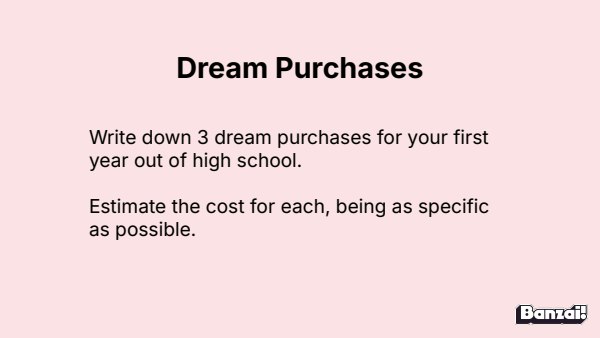
Bellringer: Dream Purchases
- Students list 3 dream purchases for their first year out of high school and estimate costs.
- Discuss the reality of funding them on part-time wages.
Instruction
- Define financial literacy using the language-literacy analogy.
- Cover stakes of financial mistakes, needs vs. wants, and budgeting as intentionality.
Discussion: The Adventure Funding Dilemma
- Groups tackle a $3,000 travel goal requiring $125/month in cuts.
- Debate trade-offs and name the personal values each choice reflects.
Activity: Map Out Your Needs & Wants
- Students complete the Map Out Your Needs & Wants worksheet.
- Categorize expenses as needs vs. wants and reflect on which spending aligns with their values.
Wrap-Up & Assessment
- Write down the most important value you identified today.
- What is one specific action you could take to pursue that value?
| Est. Time | Activity | Description |
|---|---|---|
| 7 min | Bellringer: Dream Purchases |
|
| 10 min | Instruction |
|
| 12 min | Discussion: The Adventure Funding Dilemma |
|
| 12 min | Activity: Map Out Your Needs & Wants |
|
| 4 min | Wrap-Up & Assessment |
|
Lesson Prep

Map Out Your Needs and Wants
It's vital to understand your personal needs and wants when establishing a budget.
Class Presentation
Includes a 24-slide deck with teacher notes. Present from Banzai, download a PDF, or copy it to Google Slides.


Presentations, Ready to Go
- Built-in PresentationPresent full screen, straight from Banzai
- Copy to Google SlidesMake an editable copy for your class
- Download or PrintSave as a PDF or print
- Teacher NotesSlide-by-slide guidance, printable as one handout
Unit 1: Money Fundamentals

Financial Literacy: The Basics
Money isn't just math—it's a reflection of your values, goals, and vision. This lesson defines financial literacy, explores its real-life stakes, and connects everyday spending choices to what matters most to students.

Opportunity Cost
Every choice has a hidden cost, called the opportunity cost. In this lesson, students evaluate trade-offs by identifying the next-best alternative they give up when making a decision.
Setting S.M.A.R.T. Goals
A goal without a plan is just a wish, and most wishes don't come with price tags. This lesson introduces the S.M.A.R.T. goal framework and connects it to real savings strategies so students can turn vague financial intentions into actionable plans.
How do Banzai lesson plans work? See the FAQ.