
Lesson
Entrepreneurship Part II
Summary
Entrepreneurship involves taking on financial risk in hopes of earning a profit. This lesson focuses on the math and risks of starting your own business—break-even analysis, legal structures of new businesses, bootstrapping, and the hazards of early businesses.
Bellringer: T-Shirt Break-Even
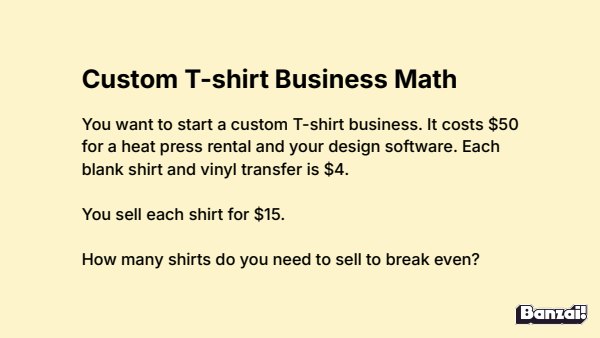
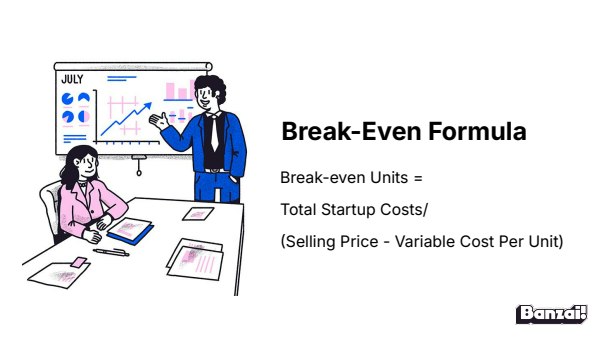
- Students solve a custom t-shirt business problem — $50 startup, $4 per shirt, $15 selling price — to find how many shirts cover costs.
- Introduce the term "break-even point" once they reach an answer.
Instruction
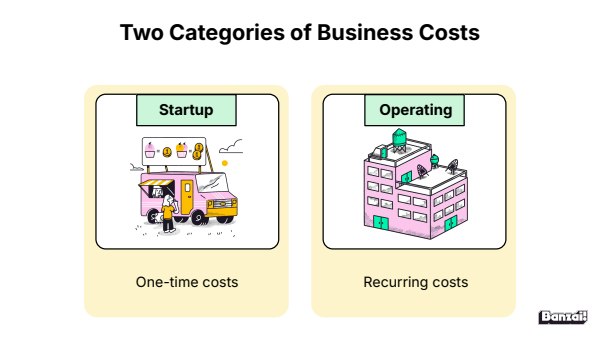
- Walk through startup vs. operating costs, the break-even formula, legal structures (sole proprietorship vs. LLC), business insurance, and bootstrapping vs. business loans.
Discussion: Why Businesses Fail
- Students recall a real business that closed and speculate on why it failed.
- Use student examples to walk through four failure categories: high startup costs, rising recurring costs, low sales, and accidents/lawsuits.
Activity: How Much Can My Business Make?
- Students complete the How Much Can My Business Make? simulation, applying break-even and cost concepts.
- Complete the vocab and posttest
Wrap-Up & Assessment
- Give an example of a startup cost and a recurring/operating cost.
- If your break-even point is 5,000 units but the market only has 500 customers, is this a viable business? Why or why not?
| Est. Time | Activity | Description |
|---|---|---|
| 5 min | Bellringer: T-Shirt Break-Even |
|
| 10 min | Instruction |
|
| 10 min | Discussion: Why Businesses Fail |
|
| 15 min | Activity: How Much Can My Business Make? |
|
| 5 min | Wrap-Up & Assessment |
|
Lesson Prep

How Much Can My Business Make? Game
Students find out what it will take to earn a profit with a small business.

How Much Can My Business Make? Vocab
Review the vocab terms from How Much Can My Business Make?

How Much Can My Business Make? Posttest
Assess how much students learned in the simulation.
Class Presentation
Includes a 17-slide deck with teacher notes. Present from Banzai, download a PDF, or copy it to Google Slides.



Presentations, Ready to Go
- Built-in PresentationPresent full screen, straight from Banzai
- Copy to Google SlidesMake an editable copy for your class
- Download or PrintSave as a PDF or print
- Teacher NotesSlide-by-slide guidance, printable as one handout
Unit 2: Career Exploration & Market Realities

Entrepreneurship Part I
Entrepreneurship is the process of starting a business to solve a problem, taking on financial risk in hope of earning a profit. This lesson talks about business ideas, value propositions, market research, and competitor analysis.

Entrepreneurship Part II
Entrepreneurship involves taking on financial risk in hopes of earning a profit. This lesson focuses on the math and risks of starting your own business—break-even analysis, legal structures of new businesses, bootstrapping, and the hazards of early businesses.

High-Growth Labor Markets
Not all growing industries are created equal. A tiny field doubling in size can still offer fewer jobs than a giant field inching up 5%. Explore the difference between growth rate and total job volume, and identify the macro forces reshaping which careers will boom over the next decade.
How do Banzai lesson plans work? See the FAQ.